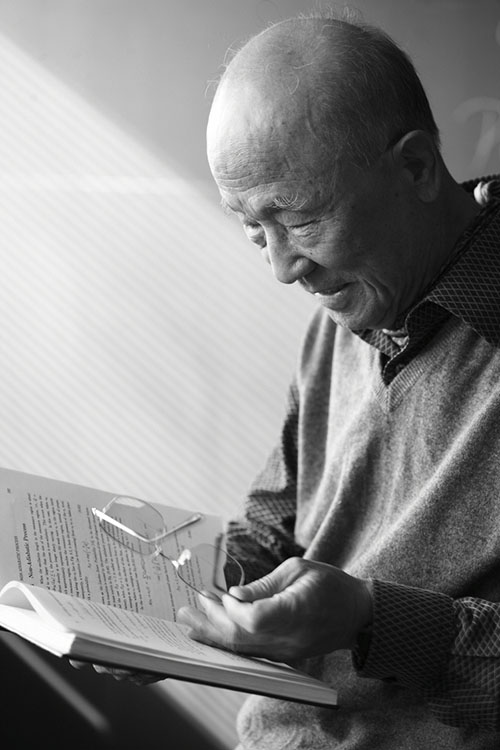
1934 Born in Hiroshima, Japan
1958 Graduated from Seoul National University, Department of Physics (Presidential Award recipient)
1960 Enrolled in the Department of Physics, University of Notre Dame
1963 Ph.D. in Physics from Indiana University
Research Fellow, University of Pennsylvania
1966 Appointed as Professor at Johns Hopkins University
1997 Became the Founding Director of the Korea Institute for Advanced Study (KIAS)
1998 Awarded the Moran Medal of the Order of Civil Merit (Korea)
2000 Board Member, Vietnam Education Foundation (appointed by the U.S. Government)
2001 Recipient of the Cheongam Science Prize, The Korean Academy of Science and Technology
Prof. Chung Wook Kim, the founding president and second president of the Korea Institute for Advanced Study (KIAS), who made significant contributions to the advancement of basic science research in Korea, passed away on November 29, 2024. Per his wishes, the funeral was held privately as a family ceremony.
Born in Hiroshima, Japan, in 1934, Prof. Kim experienced the unimaginable devastation of the atomic bomb as a young fifth-grader. This harrowing experience ignited his awareness of the power of science and nurtured his deep curiosity about the mysteries of nature. After returning to Korea with his family, he led a relatively ordinary youth, enjoying soccer during his middle and high school years. At Seoul National University, he pursued his studies in physics while excelling as a track and field athlete, further deepening his passion for science
Encouraged by his mentor, Professor Soon-Tak Cho, Prof. Kim pursued graduate studies at the University of Notre Dame and later transferred to Indiana University, where he specialized in beta decay under the mentorship of Professor Emil Konopinski, a member of the Manhattan Project's theoretical group. His path then led to a fruitful collaboration with Henry Primakoff at the University of Pennsylvania, during which Prof. Kim established himself as a world-renowned expert. He introduced the groundbreaking Kim-Primakoff method for understanding weak nuclear interactions, earning him international acclaim. In 1966, he joined the faculty of Johns Hopkins University as a professor.
Prof. Kim’s contributions to neutrino physics were monumental. He made significant advancements in understanding neutrino oscillations in matter and quantum mechanical neutrino phenomena wave-packet treatment of neutrino oscillation. His 1993 book, Neutrinos in Physics and Astrophysics, remains a classic in the field. His collaboration with Professor Carlo Giunti of the University of Torino led to the publication of Fundamentals of Neutrino Physics and Astrophysics in 2007, a definitive work in the field. Additionally, in 1991, he played a pioneering role in supersymmetry theory by proposing the unification of three fundamental forces—strong, weak, and electromagnetic—into a single grand unified force
Prof. Kim was not only a brilliant physicist but also a natural educator and captivating speaker. His lectures, delivered with enthusiasm and light humor, resonated deeply with students and audiences. His visits to Korea included lectures on neutrino theory, which became a cornerstone of research development in the country
As the founding president of KIAS in 1997, Prof. Kim demonstrated his exceptional administrative skills by creating an environment where researchers could engage in creative and independent studies. Under his leadership, KIAS quickly gained recognition as a world-class research institution. His efforts also significantly impacted the development of neutrino theory and experimental research in Korea. The establishment of the RENO experiment, which was the first to measure the final neutrino mixing angle, and the Center for Underground Physics (CUP) at the Institute for Basic Science (IBS), designed to investigate rare beta decay phenomena, is greatly attributed to the leadership and vision of Prof. Kim.
Prof. Kim was a true Renaissance man, balancing work and life with remarkable ease. He embraced adventure, enjoying skiing, golfing, fine dining, and art. In his seventies, he began scuba diving, amassing hundreds of dives.
Prof. Kim’s achievements and virtues will forever inspire the numerous students and scholars he mentored and collaborated with. Professor Jeong-Hyun Song of Konkuk University, his sole Korean mentee, shared a heartfelt tribute
Click here to read Jeong-Hyun Song's tribute