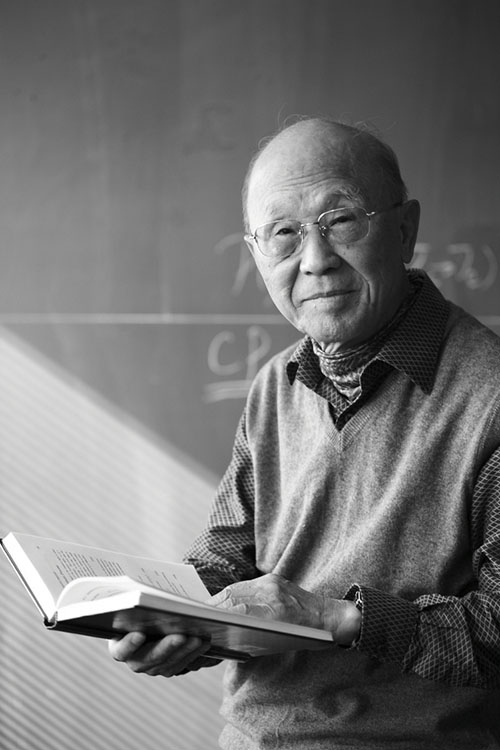
Chung Kim, a renowned theoretical particle physicist and beloved father and grandfather, passed away on November 29, 2024 in Korea. He was 90 years old. Through a remarkable journey shaped by extraordinary experiences, he left an indelible mark on many people, organizations, and countries through his dedication to advancing science and understanding the smallest particles in the universe. Beyond his scientific pursuits, Chung was a true Renaissance man who embraced life with deep passion and joy and whose diverse talents knew no limits.
Born in 1934, Chung was the only son among six children born to Korean parents living in Japan, where his father owned an engineering and manufacturing company. He excelled as a student, while cultivating a love of sports, nature, and his wide circle of friends. On what would become the most defining moment of his life, Chung was five miles from ground zero on August 6, 1945 when the U.S. dropped the atomic bomb on Hiroshima. From living through the bomb and its aftermath, Chung experienced devastation that he could never forget and rarely spoke about during his life. Yet, amid the unimaginable tragedies, the very force that wrought destruction became a source of profound curiosity and a doorway to understanding the mysteries of science, a relentless pursuit of knowledge, and a quest to live life fully. His friend and Nobel laureate Robert Laughlin, wrote about Chung’s experience in his book, A Different Universe, and shared, “His story has an especially poignant ending, for Kim later became a respected neutrino physicist and wrote an excellent textbook on the subject that is still widely used today.”
Following World War II, like many Koreans in Japan, the Kim family returned to Korea. In the abrupt transition back to their home country, the family faced many obstacles and lost the entirety of their assets and belongings. Between the hardships his parents faced upon their return, including the loss of three of his sisters, Chung’s teenage years were difficult, and he channeled energy into his schooling. After high school, he served with distinction in the Korean navy before earning admission to Seoul National University.
At Seoul National University, Chung excelled as a top physics student and soccer player while supporting his family through tutoring. He met Young Ja Kim, the only female physics student at the time, who would become the love of his life. Chung graduated as valedictorian in 1958 and received the first-ever presidential commendation for extraordinary achievement from South Korean President Syngman Rhee. With $50 and a small bag of clothing, he left Korea for Indiana in 1959, where he earned his M.S. from the University of Notre Dame and his PhD in physics from Indiana University in 1963. Young eventually followed him to Indiana, where she earned her M.S. in physics at Indiana University. They married in 1960 and fully embraced life in the U.S., from hosting fellow graduate students weekly with their growing appreciation of hamburgers, pizza, and Boston cream pie to learning to love college football. Their only child, Janet, was born in 1961.
After a post doc at the University of Pennsylvania, Chung joined the Johns Hopkins University faculty in 1966, where he spent over 30 years as a professor, Vice Chair of the Department of Physics and Astronomy, and Director of the Graduate Physics Program. Deciding that two physicists in the family was one too many, Young received her PhD in Biostatistics at Johns Hopkins, became a renowned mathematical demographer, and served on the faculty of the Bloomberg School of Public Health until her passing in 2005. Life in Baltimore was full — research, teaching, welcoming and feeding graduate students year-round, playing golf, hosting popular dance parties for their Korean Social Club friends, and hiking and fishing. Through many visiting professorships, research affiliations and consultancy assignments, Chung and Young traveled and worked on every continent except Antarctica. Paris, Torino (especially his fellow physicist and lifelong friend Sandro Bottino and his wife Piera), and Florence became their homes away from home, and being a true gourmand, Chung was always the first to gather friends and colleagues over a fine meal and good wine. During these years, Chung’s passion for life flourished with a love of adventure, skiing and golf, karaoke, telling jokes, art and antiquities, nature and wildlife, and his pursuit of becoming an amateur magician. Also, throughout their lives, Chung and Young supported countless organizations around the world dedicated to wildlife, nature, science, and those less fortunate.
In 1996, Chung was asked by the Korean government to serve as the Founding President of the Korean Institute for Advanced Study/KIAS (modeled after the Institute for Advanced Study in Princeton, NJ). His decision to return to his native country was driven by his aspiration of a leading national institute devoted to basic scientific research, and KIAS was the first of its kind in Korean history to strategically invest in theoretical basic sciences. Chung served two terms and continued as a professor emeritus and advisor to the government on science. He brought Stephen Hawking, Jane Goodall, and many post docs and scientists including several Nobel laureates to Korea. “His vision and dedication laid a foundation for KIAS, transforming and pioneering ideas into a globally respected institution. His profound legacy continues to inspire all of us,” shares President Tae Won Noh, the current KIAS president.
Chung also served as a member of the Advisory Committee for Basic Science under the Korean Ministry of Science and Technology, and on the Board of Trustees of the Princeton Institute of Advanced Study (Science Institutes Group), the Korean Academy of Science and Technology, and the National Science Museum in Korea.
In 1998, Chung received Korea’s highest civilian honor, the Korean National Decoration/Moran Order of Merit from the Korean government for his outstanding contributions to Korea and in 2000, he received a U.S. presidential appointment from President George W. Bush to serve as a Founding Director of the inaugural Vietnam Education Foundation (VEF) — an initiative to further the bilateral relationship between the U.S. and Vietnam through improving education in Vietnam, particularly in the fields of science, technology, engineering, mathematics (STEM), and medicine. He received the Chong-Am Science Award from the Korean Academy of Science and Technology and in 2001, Chung was profiled in Esquire Magazine as one of “Ten Remarkable Men” in Korea for his achievements as the “Pioneer for science in Korea.”
Chung contributed to many subjects in theoretical physics: weak interaction in nuclear processes, particle gauge models, grand unification schemes, cosmological models, neutrino physics and astrophysics. The possibility of a grand unification of three running coupling constants of strong, electromagnetic, and weak interactions in the framework of super-symmetry theories was first demonstrated by Chung. He authored three influential books; most remarkably, the 2007 Fundamentals of Neutrino Physics and Astrophysics, which remains a fundamental textbook on the many facets of neutrino properties.
And yet, despite his accomplishments and accolades, Chung will be remembered most for his humanity, determination, generosity, mentorship, humor and joy for life, and insatiable curiosity. After Young’s passing in 2005, he learned scuba diving at 73 and completed 600+ dives while mastering the art of underwater photography and befriending some of the world’s most celebrated photographers. Michael Kosterlitz, Chung’s friend and Nobel laureate, who spent considerable time at KIAS recalls him as, “a very alive man who loved physics and diving in different parts of the world. We always enjoyed talking about our passions outside of physics.” By 75, he was zip-lining and wakeboarding to keep up with his grandchildren.
Chung was pre-deceased by his wife Young and two sisters. He is survived by his daughter Janet Cahill, her husband Andrew, and two grandchildren Christine and Jack, whom he admired and adored; sister Poong Mee Lee and nephew Ben; sister Malmee Lee, her husband Hyoil and nephew Joon; Jinny (Myung Jum Jin), his longtime caregiver to whom the family is incredibly grateful and his beloved dog Benny Jr. The family is also enormously grateful to Drs. Ho Jung Kim and Yong Son Koh for their unwavering and dedicated care of Chung over the past three and a half years, and to Sunshik Min and Daniel Lee for their invaluable help and support to his family in Korea.