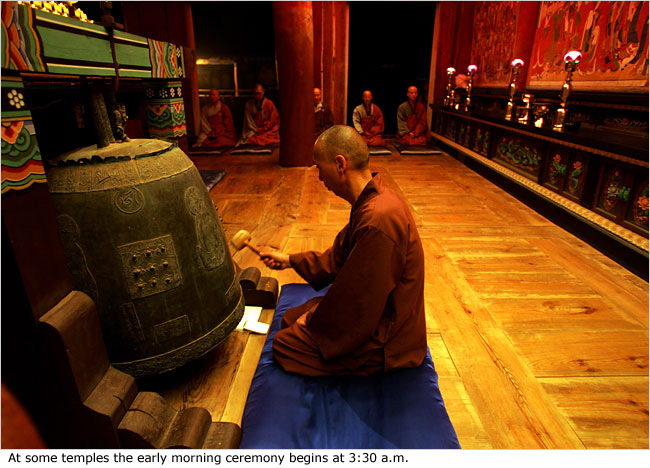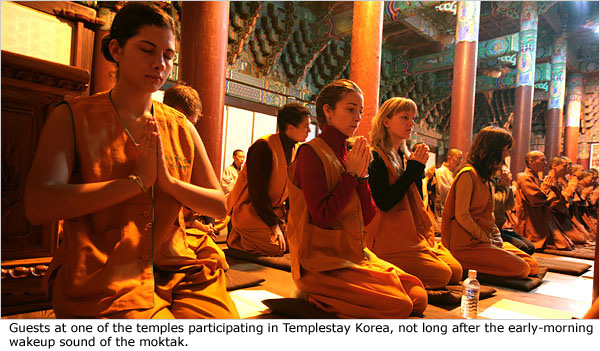
AT 3:30 a.m. in a temple in South
Korea the sound of the moktak -a wooden percussion instrument that Buddhist
monks play every morning to start the temple's day -jolted me awake. I pulled
myself up from my floor mat, straightened my itchy gray uniform and stumbled
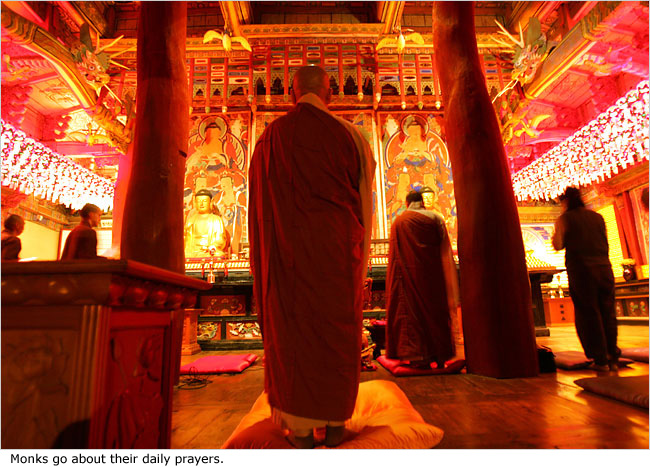
through the pre-dawn darkness to the temple, where pink lotus lanterns
illuminated a small group of people waiting to begin their morning prostrations.
I was at the Lotus Lantern International Meditation Center on an overnight
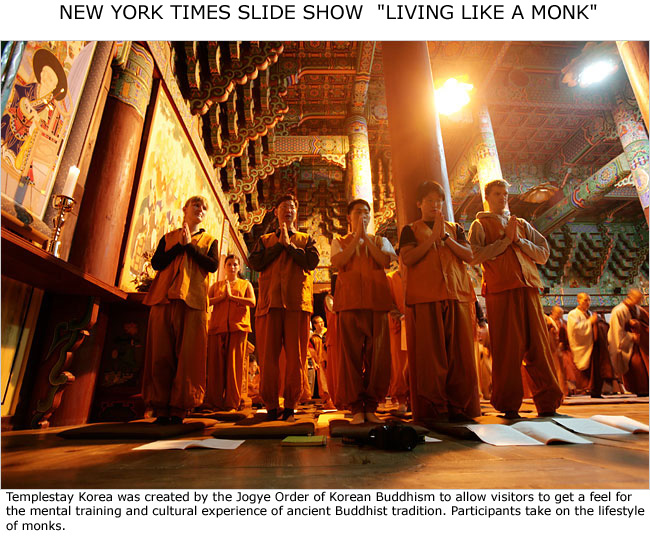
trip run by an organization called Templestay Korea. Created by the Jogye Order
of Korean Buddhism -the largest Buddhist order in Korea, the program aims to
allow visitors to "sample ordained lifestyle and experience the mental training
and cultural experience of Korea's ancient Buddhist tradition," according to its
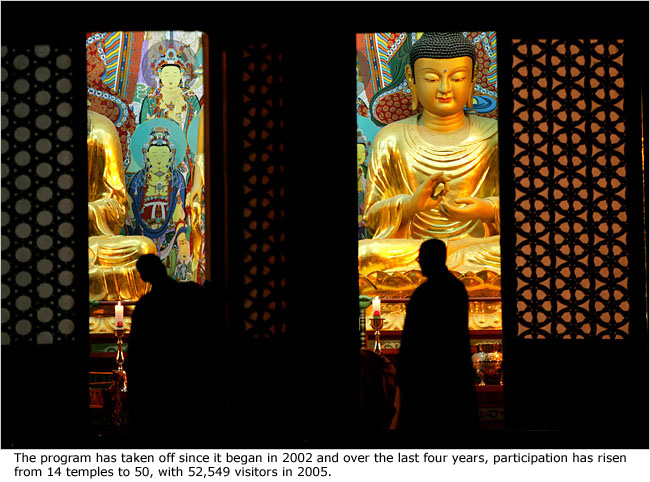
Web site. Although the program only began in 2002 on the occasion of the World
Cup soccer tournament held in Korea and Japan,
it has grown swiftly over the last four years from 14 temples to 50, with 52,549
participants in 2005.
The meditation center on Ganghwa Island, about two hours from Seoul
by public transportation, certainly seems like the sort of place that could
inspire calm. The grounds are nestled between rice paddies and a leafy forest,
and the center's brightly painted temple sits several stone steps up from a
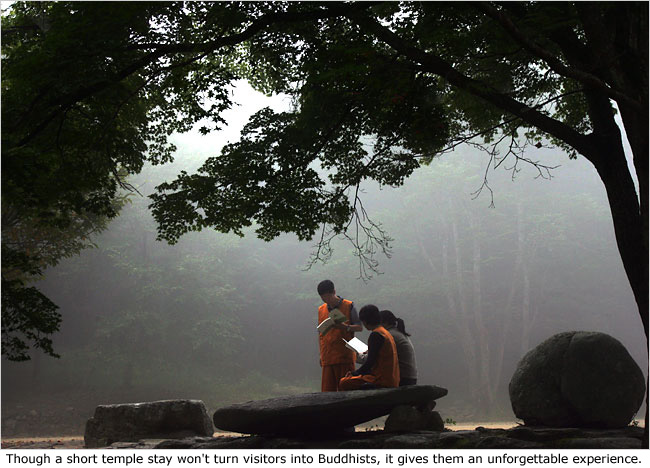
gentle brook and a small pond stocked with lotus flowers and koi. Monks wander
silently, occasionally gathering at an outdoor wooden table and offering tea and
small snacks to guests.
But be forewarned -the point of the temple stay is not, as the pictures on
its Web site might make it seem, to lounge next to a brook nibbling crackers as
you consider what it means to reach nirvana. The point is to live like a monk.
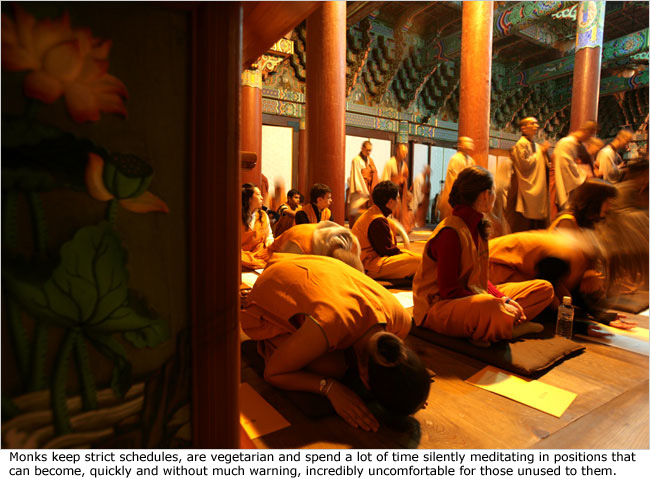
And monks, it turns out, keep strict schedules, are vegetarian and spend a lot
of time silently meditating in positions that can become, quickly and without
much warning, incredibly uncomfortable for those unused to them.
I got my first hint of this austere lifestyle when I arrived and was greeted
by Cho Hyemun-aery, who introduced herself in fluent English. In the guesthouse,
she showed me the communal bathroom and the small room my friend and I would
stay in, which was unfurnished except for sleeping pads, blankets and small
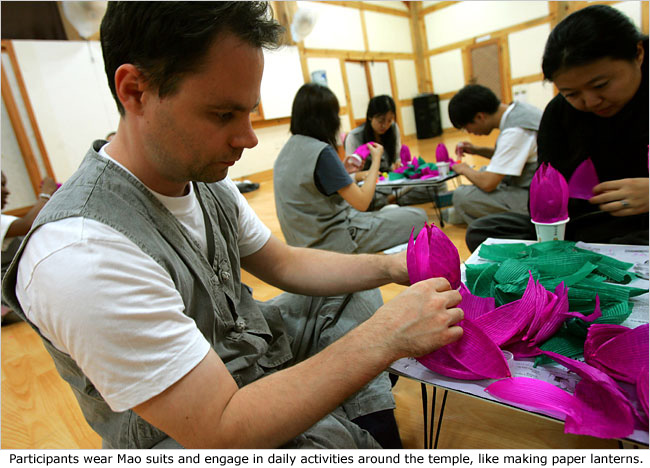
pillows. Then, after we'd dropped off our bags, Ms. Cho handed us our clothes
for the weekend: two identical extra-large sets of baggy gray pants and vests,
along with sun hats and blue plastic slippers. We looked like we'd stepped out
of a propaganda poster for Maoist China.
On this particular temple stay, the first activity was community work time.
Clad in our Mao suits, we followed Ms. Cho to the garden, where eight or so
other guests squatted between raised rows of dirt, piles of potatoes scattered
around them. Our job was to sort the potatoes into piles of small, medium and
large, as monks walked by, examining our efforts. We worked in silence, sweating
under the afternoon sun, and were rewarded when we'd finished with small,
freshly boiled potatoes, lightly salted and offered to us by a grinning
Vietnamese monk.
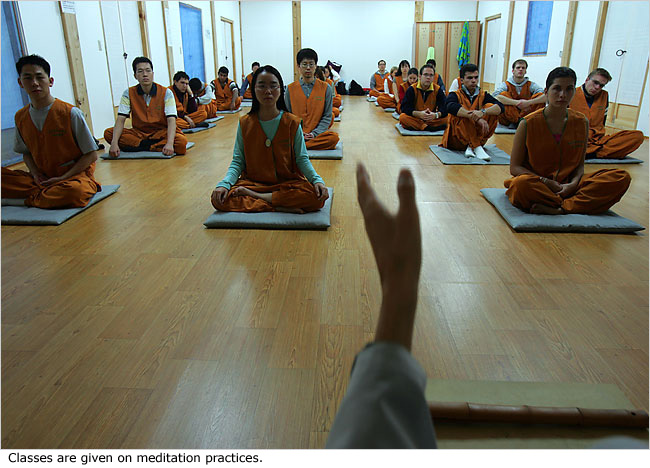
After our snack, we wiped the dirt off our pants and gathered in the temple,
where Ms. Cho showed us how to arrange our slippers neatly at the door, and
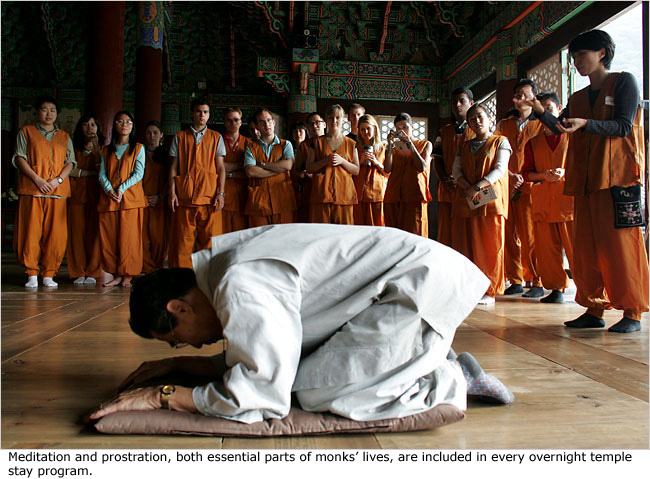
taught us to prostrate according to the Korean Buddhist tradition: kneel down,
touch your forehead to the floor and rest your hands, palms up, on the ground.
We then meditated silently for half an hour, a slight breeze blowing through the
open doors at our backs as we sat cross-legged on our prayer mats, trying to
clear our minds.
Meditation and prostration, both essential parts of monks' lives, are
included in every overnight temple stay program, as are meal or tea ceremonies,
lectures on Buddhism and exceptionally early wakeup calls. Beyond that, though,
programs differ. Most average about 30,000 South Korean won (approximately $33,
at 972 won to the U.S. dollar) a night, but temple stays can range anywhere from
a few hours to a few months, depending on your budget and enthusiasm.
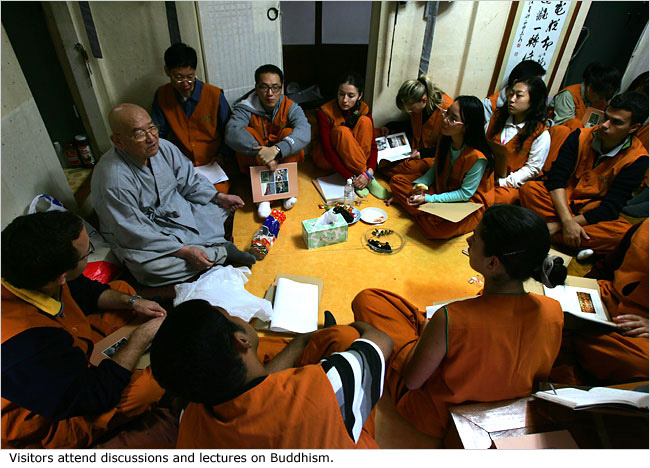
They also offer different activities. Lotus Lantern's program included
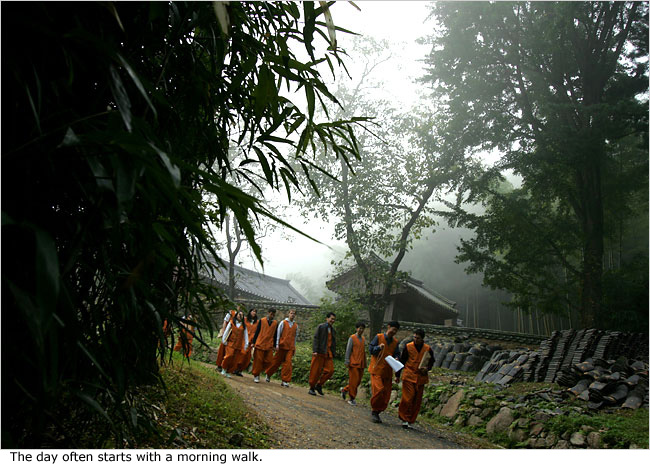
walking meditations through the temple grounds, calligraphy practice, a
traditional Buddhist meal ceremony and a discussion about Buddhism led by the
temple's head monk. But other temples offer Buddhist martial arts, stone
rubbings, hiking and painting. And the buildings themselves can also vary, from
newly built meditation centers to temples that are more than a thousand years
old.
Golgulsa Temple, for example, about five hours from Seoul on public
transportation, was built by an Indian monk in the sixth century and is
surrounded by ancient stone caves. Its program is more physically active than
the other temples', offering training in a Korean Buddhist martial art called
sunmudo that incorporates traditional martial arts with yogalike poses, weapons
training and breathing exercises.
Musangsa Temple, about two hours from Seoul, caters to people who don't want
to limit a wee-hours wakeup call to just one morning -it has extended
temple-stay programs during the summer and winter seasons that can last for up
to three months (new participants can join on Saturdays, pending approval from
the temple's abbot). The retreats at Musangsa are silent, so if you think rising
before dawn and performing 108 prostrations before starting a 10-hour-long day
of strictly scheduled temple activities might make you want to scream, try a
different program.
An easier option is Jogyesa Temple, right in Seoul, at 27-11 Gyunji-dong,
which offers half-day visits on the last Saturday of every month that include a
tea and meal ceremony, meditation practice and a temple tour. If you won't be
around on the last Saturday and can scrape together a group of five or more
people, you can also organize your own day at the temple, even on weekdays -
just make sure to e-mail five days in advance for reservations. The e-mail
address is 10mirror@ijogyesa.net.
Jun Jong-young, a temple-stay coordinator, said she wasn't sure what exactly
had caused the explosion in the program's popularity, which saw an increase of
15,647 participants between 2004 and 2005 alone -but she did have some
theories. "Korea's economy is better now," she said, "and people are busier and
more stressed. They want to set aside time for a more cultural experience."(Min
Tae-hye, another coordinator, said North Korea's recent nuclear tests have had
no effect on interest in the program.)
ON my particular temple stay, I was fascinated by the variety of people the
program had attracted. I was the only American; my fellow participants came from
Australia,
Canada,
Venezuela and France.
What made us all want to spend a Saturday night sleeping on the floor?
For Kayte Lowri Pritchard, a 24-year-old from North Wales
who came to Korea as an English teacher, the temple stay offered activities and
a community she found lacking in her normal life. "I came again and again every
weekend, quickly preferring the temple and sunmudo training to the usual
Saturday night activities, which involved drinking a lot of alcohol and feeling
awful all day on Sunday," she told me in an e-mail. Today, she helps run
Golgulsa's program. "It's like having a big extended family," she said.
"Everyone is so caring and kind."
Of course, doing a weekend temple-stay program won't immediately turn you
into a Buddhist. As Ms. Cho put it, talking about Buddhism without proper,
consistent, mindful practice is "like looking at a finger pointing at the moon,
instead of looking at the moon itself." But spending two days at a temple
certainly does give a sense of what a monk's schedule is like -an experience
that, despite its accompanying fatigue, is not easily forgotten.
After our final group meeting, my friend and I cleaned our room and handed
our itchy suits to Ms. Cho, happily changing into our normal clothes and
fantasizing about the dinner we would have when we returned to Seoul. Several
days later, Ms. Cho e-mailed the weekend's participants and invited us to a
workshop to perform 3,000 prostrations to "inspire yourself into practice." It
sounded horrifying, and after a moment's thought, I realized why: the temple
stay had demonstrated how difficult it would be for me, with my anxieties and
preoccupations, to live like a monk. Which, when I think about it, may have been
the point.
Reservations can be made through the Templestay program's
English Web site: http://www.templestaykorea.com/. It includes links and contact
information for all the temples listed above, plus information for other temples
that don't offer English translations.